


Representatives of farmers from Changhua County’s Sijhou Township (溪州) and farming activists protested outside the National Science Council (NSC) building in Taipei yesterday after the council neglected to invite them to take part in a meeting about a project to divert water from their local irrigation system to the Central Taiwan Science Park.
“The Cabinet promised to call a meeting on the controversial project within a week after hundreds of farmers staged a five-hour sit-in outside the Executive Yuan under a baking sun last week,” said Lin Le-xin (林樂昕), a member of the Taiwan Rural Front. “Instead of calling the meeting itself, the Executive Yuan asked the NSC to do so and most of the participants are those who support the project, while the farmers — who are the most affected — are excluded.”
Attendees at the meeting included Changhua County Commissioner Cho Po-yuan (卓伯源), Chinese Nationalist Party (KMT) legislators Lin Chang-min (林滄敏) and Cheng Ju-fen (鄭汝芬), and Changhua Irrigation Association chairman Lu Lu-shan (呂爐山).
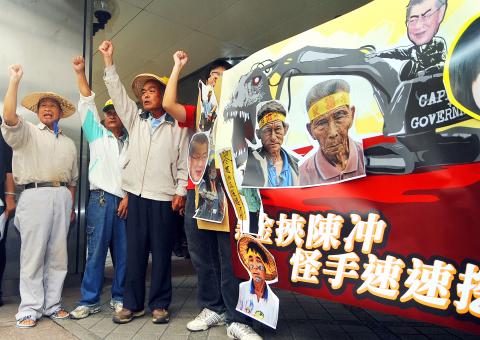
Photo: Liao Chen-Huei, Taipei Times
Democratic Progressive Party legislators Tien Chiu-chin (田秋堇) and Lin Shu-fen (林淑芬), and Sijhou Township Mayor Huang Sheng-lu (黃盛祿) — who are all opposed to the aqueduct project — decided not to attend the meeting in protest.
The disputed project is a plan, started in February, to build an aqueduct to divert water from Cizaipijun (莿仔埤圳), the main irrigation system in southern Changhua County, to the science park’s fourth-phase campus in Erlin Township (二林).
While local farmers have long opposed what they consider “water-jacking,” the NSC announced that, since the Erlin campus project was not going as smoothly as planned, it would readjust the project and halt construction of the aqueduct.
That announcement was welcomed by the farmers, but their joy did not last long because construction continued. The NSC later said that, despite the decision by National Science Council Minister Cyrus Chu (朱敬一) to stop the construction, it had to be continued because the council had to honor a contract.
“On one hand, the NSC says it is readjusting the plan for the Erlin campus, yet on the other hand, it is continuing with the construction of an aqueduct which is very likely to become useless,” Taiwan Rural Front spokeswoman Frida Tsai (蔡培慧) said. “When the NSC calls a meeting to talk about the controversial aqueduct, it mostly invites those who support it.”
“The government is insincere and the meeting is useless,” Tsai said.
Tsai, along with the farmers, tore up copies of a notice about the meeting.
Farmer Pao Wan-tien (包萬添) said that each extra day of construction was one more day of taxpayers’ money wasted.
The meeting ended at about 6:30pm and National Science Council Vice Minister Hocheng Hong (賀陳弘) told a press conference that the council would continue construction of the aqueduct to honor its contract until a major decision is made to readjust the plan for the Erlin Campus.
“We’ll speak with other ministries and government agencies to see how the plan for Erlin Campus can be changed,” Hocheng said. “We will do it as soon as possible, but it will take at least two months.”


UPGRADE: The Kang Ding-class frigate is replacing its Chaparall missiles with Tien Chien II and Hua Yang VLS, which would provide it with long-range, 360° air defense Taiwan plans to produce 1,200 to 1,376 Hai Chien II missiles (海劍二, Sea Sword II) — also known as TC-2N — to serve as the standard air defense system of the navy’s surface combatant fleet, a source said yesterday. Last week, the Hai Chien II, the naval version of the Tien Kung II missile (天劍二, Sky Sword II), completed a live-fire test in waters off the National Chungshan Institute of Science and Technology’s Jiupeng facility (九鵬) in Pingtung County’s Manjhou Township (滿州). The MIM72 Chaparral and other dated air defense missiles that currently arm Taiwanese ships have inadequate range to combat Chinese

REASONS FOR TRAVEL: An assistant professor said that proposed amendments to penalize drivers if they used drugs overseas would not deter people from traveling People who operate a motor vehicle under the influence of marijuana would have their driver’s license revoked, even if they used the substance while overseas, the Ministry of Transportation and Communications said yesterday, citing proposed amendments to the Road Traffic Management and Penalty Act (道路交通管理處罰條例). The amendments would also authorize the government to revoke the licenses of people determined to have used Category 1 or Category 2 narcotics, even if they were not operating a vehicle while under the influence of drugs, as well as ban them from taking the license test for three years, the ministry said. People aged 18 or
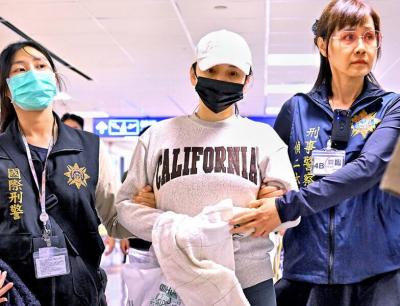
Johanne Liou (劉喬安), a Taiwanese woman who shot to unwanted fame during the Sunflower movement protests in 2014, returned to Taiwan last night after being deported from the US. She is to stand trial in Taiwan for charges involving embezzlement, fraud and drug crimes. The Criminal Investigation Bureau (CIB) said it took her into custody at Taiwan Taoyuan International Airport and would first question her before transferring her to the New Taipei District Prosecutors’ Office. She was arrested upon disembarking a flight from San Francisco that landed shortly before 7pm. Liou absconded to the US in 2019 after jumping bail
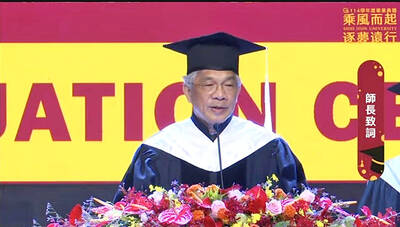
Shih Hsin University President Chen Ching-he (陳清河) yesterday issued a public apology for comments made in his commencement speech last week, stating that he has asked the school to suspend his duties and halt his wages for two months as a show of contrition. At the commencement ceremony on May 30, Chen said, “If you don’t manage your time well, or your own emotions, or your health, then I am telling every one of you — put a quick end to ‘you,’ because the world has no need for ‘you.’” The comments have sparked significant controversy online, and Chen through an open


 RSS
RSS